
Payroll
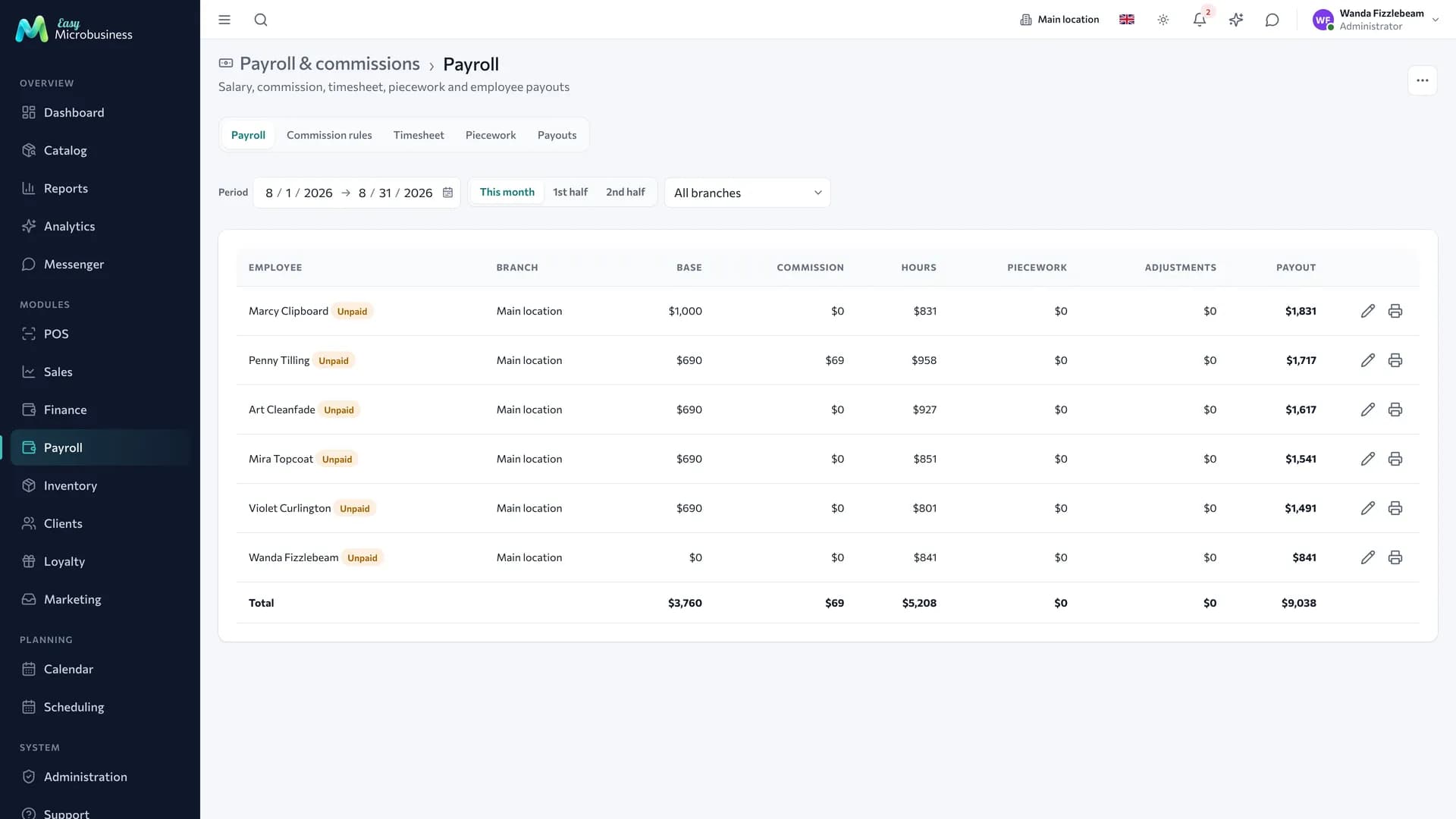
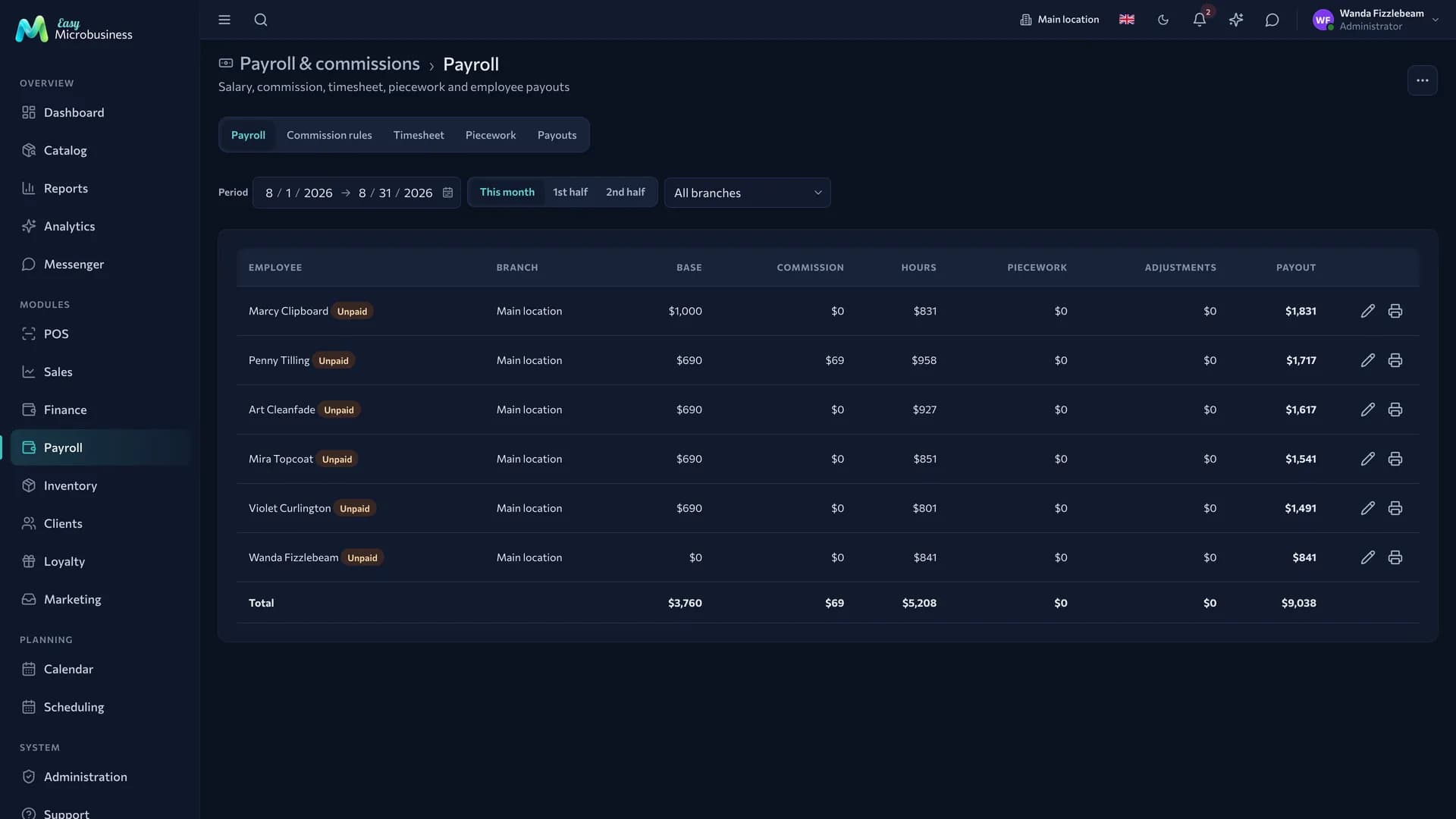
The component works out what the company owes each employee for a period and records the payout. The period is a calendar month.
Earnings are made of four parts: a salary, commission on revenue, pay for hours worked and piece-rate pay. Any part can be zero.
How to close a month
- Check the timesheet: hours and shifts are in place, holidays and sick leave marked.
- Make sure work orders for completed work are closed.
- Enter adjustments: advances, bonuses, deductions.
- Open the calculation for the period and check the amounts per employee.
- Record the payout — the system saves a snapshot of the calculation and creates an expense.
- Hand out payslips.
The calculation runs on request and shows current data. A recorded payout is a snapshot: it stays as it is even if a new sale appears afterwards.
Commissions
A commission is described by rules: what it is taken on, how much and for whom.
| Field | Values |
|---|---|
| Employee | A specific person or a company-wide rule |
| Scope | A service, a product, a category or everything |
| Type | A percentage or a fixed amount |
| Value | Per cent or an amount per unit |
Rules overlap deliberately: you can set 10 % on everything and 20 % on one service. The most specific one wins: a service beats a product, a product beats a category, a category beats a rule on everything. On a tie, priority decides.
A fixed rate has two multipliers, and only one of them is used:
- Count by shift hours — the rate is multiplied by the hours, the "Rate per hour, ₽" field. That is how a shooting or coaching hour is paid.
- Rate per attendee — the rate is multiplied by the number of attendees marked "attended", the "Rate per person, ₽" field. A group class on packages costs 0 ₽ and a percentage of it gives zero, so paying per person makes sense.
In the accrual preview the units are labelled differently — ₽/h and ₽/person.
Commission is accrued on revenue from sales, orders, deals and bookings.
Timesheet
The timesheet holds hours and shifts by day: a row per employee and date. Hours are entered by hand or collected from work shifts in the calendar.
Piece-rate pay
Where people are paid for results, output is recorded: a number of units and a rate per unit. That is how crews, seamstresses and press operators are paid.
Output is entered by hand or comes from closed work orders: the amount for the marked works is split by the shares of the crew members and lands in piece-rate pay on the closing date. Before closing the system names the amount, and afterwards it shows who received how much.
Lines that came from a work order stay as they are; a mistake is corrected with an adjustment in the same period. Manual output lines are edited freely.
How many work orders were closed, across how many sites and for how much is in the "Crew output and load" report on the Payroll tab in Reports.
Adjustments
A period also takes manual adjustments: an advance, a deduction, a bonus, a penalty. Each has an amount and a comment, so a month later it is clear what it was for.
Payout
A payout is recorded once per employee and period. At that moment a snapshot is saved: how much was accrued as salary, commission, hourly and piece-rate pay, the total of adjustments and the amount to hand over.
At the same time an expense is created in finance under the "payroll" category, so the money shows up in the profit report.
Payslip
An employee can see a payslip for the period: what made up the amount, what adjustments there were, how much is being paid.
Branches
The calculation takes branches into account: an employee working at several locations earns commission on the revenue they brought to each.
Statement and export
The statement for a period is exported as a table — handy to give to an accountant or keep in an archive. The export carries the same figures as the screen: salary, commission, hours, piece rate, adjustments and the total.
Frequently asked
An employee worked at two locations. Commission is counted per location, and the calculation shows the split by branch.
A sale was cancelled after the payout. The payout snapshot stays as it is. The difference is handled with an adjustment in the current period, which leaves a trace in the statement.
Who sees payroll. The section is open to administrators and directors. An employee sees their own payslip.
A commission was not accrued. Most often the record is not finished yet: commission is counted on completed sales, fulfilled orders, won deals and attended visits.
In short
- Earnings are made of salary, commission, hours and piece-rate pay.
- Of overlapping commission rules, the most specific one wins.
- A payout is fixed as a snapshot and creates an expense in finance.
- Mistakes after a payout are corrected with an adjustment in the current period.
Related components
- Point of sale, Orders, Deals, Scheduling — the revenue sources for commission.
- Calendar — work shifts for the timesheet.
- Finance — a payout becomes an expense.
- Reports — payroll in profit and crew output.